Frankie Valli and the Four Seasons spent 1971 to 1974 recording for Motown/MoWest — and released only a fraction of what they cut. The Sessions pages that follow this one tell that story the way the tapes themselves tell it: session by session. Every entry there starts with the original Production tape (a “P tape”) a song was recorded onto, then follows what happened to it afterward — further storage copies, safety and mixing copies (“T tapes”), and the handful of cases where the same backing track resurfaced years later under a different artist’s name entirely.
On the data itself: the writer, producer, arranger and session-date credits shown throughout come from the Tape Index and other published CD-listing-type sources — historical record, not anyone’s private notes. A separate body of material — unpublished collectors’ notes and tape-disclosure research — is being held back for its own dedicated feature later on.
How We Know What We Know
The Story Behind the Tape Index
The first hint came in 2001, with the receipt of a paper-based “Unreleased List,” passed on via a Motown Yahoo group and said to come from the Motown Tape Vault Database itself. A second, far fuller list followed later, this time from former Motown interns — their names known to the researchers, but kept anonymous — confirming the full Frankie Valli/Four Seasons session-tape listing: what became known as the Tape Index.
Even that wasn’t the true starting point, though. An earlier listing of unreleased titles had been supplied back in the 1990s by Tom DePerrio and confirmed by Cary Mansfield — and when the Artists Cards themselves surfaced from Keith Hughes years later, they corroborated many of the same titles all over again in 2011. Separate sources, a decade or more apart, converging on the same body of unreleased work.
A contemporary press release first told of unreleased tracks: the TCB Motown Monthly Newsletter of January 1972 told fans at the time, “The group has already finished recording an album with 15 tracks in all being cut at the Mowest studios in Los Angeles. It is thought that a single will be taken from these sessions.” Half of those 15 songs were still unreleased by the time serious research resumed decades later.
In 2002, researcher Paul Nixon proposed a Four Seasons “Unreleased” project directly to Harry Weinger, then CEO at Universal Motown. The same year, Bob Gaudio himself confirmed in a phone interview that unreleased tracks existed and that he’d discussed them with Weinger — but no release followed for any of the material, whether from the early-1970s Motown sessions or a separate round of 2000-era recordings.
The idea went no further at the time. When Weinger raised it directly with Bob Gaudio, Valli’ and Gaudio’s attention was turning to the development of Jersey Boys, the stage musical launched in 2004 that would go on to become a record-breaking, world-wide success; there was no appetite left for a Motown reissue.
A second push came in 2007, again through Paul Nixon, built on the same Tape Index list of up to 40 unheard alternate versions and unreleased tracks. This time Peter Bennett, the Four Seasons Partnership’s attorney, challenged Motown’s ownership claim outright and dismissed the material as demos or unfinished … or out of key:
“Various concerns Bob and Frankie had about this reported 2-CD release, including some basic problems as to whether Motown still retains the right to the previously released masters and the basis upon which they would now assert the right to what were nothing more than demo vocal tracks by Frankie on musical tracks cut for other Motown artists for which Frankie was never paid and never approved for commercial release. Many of these ‘works’ or ‘demo’ tracks were not even in the proper key and they were never intended for commercial release and would be embarrassing and harmful to Frankie if released at this time.”
— Peter Bennett, Four Seasons Partnership lawyer, on the 2007 proposal for a Motown unreleased CD
Weinger took charge of the negotiation himself and met Gaudio again. The compromise: a 2-CD Anthology of already-released material, alongside a separate, newly recorded Frankie Valli solo album. Both arrived in 2008 — the Anthology, and Romancing The Sixties. The Anthology also carried two genuine unreleased alternates, previously heard only on demo acetate. Weinger maintained afterward that no tracks “slated for release” had been held back — a claim the research team came to see as a plain piece of wordplay rather than an honest answer.
That was the official word for years, all the same: these were ‘supposedly’ scratch or guide vocals, not real recordings. But a scratch vocal is a rough reference a singer expects to redo, and the paperwork told a different story. In 2011, the Artists Cards — Motown’s own internal recording-session record cards — reached the researchers via a Universal Motown contact who had copied them from microfiche in Motown’s own vault records; the late Keith Hughes was the one who tracked this material down and shared it. Cross-checked against the Tape Index line by line, the cards confirmed session after session as genuine, completed recordings on 16-track master tapes, several with copies also made to Safety (T) tapes — not rough guides awaiting a “real” vocal that never came.
Keith Hughes also passed on a sense of just how large a task this is. A Motown Vaults researcher once told him:
“Apparently T as well as P tapes still exist in the Vaults, like the Detroit DM [Duplicate Master] tapes — they seem to have no common format, there are Production Masters, Original Masters, Multi-Tracks, all sorts. Also, a lot of Live tapes have T prefixes. There are over 1,000 finished master tapes from the Detroit era alone in the Vaults. Some contain up to 90 tracks (e.g. a three-track tape with all three tracks full of mono masters). There are thousands more from the LA era, plus the multi-tracks, plus the live tapes … more than anyone could listen to in a lifetime. […] It is quite possible that no-one has listened to any particular tape since the last time a track was added to it. Researchers have often found tracks that no-one knew were there. One of the stock responses when someone asks, ‘Is such-and-such in the Vaults?’, is ‘With Motown, you never say never’ — even Harry Weinger has said this. Who knows? Some tracks went missing for forty years because they were filed under a different artist and a different title.”
— a Motown Vaults researcher, as recounted by the late Keith Hughes
That last line is the whole reason the “reassigned elsewhere” cases on the Sessions pages matter: a backing track filed under the wrong name is, as far as any catalogue search is concerned, simply gone — until someone happens to recognise it. The fact was that all of the tracks were recorded for a specific purpose and at least 30 were complete and unheard in 2008.
2010 brought the clearest proof yet: three songs Bob Crewe had completed in 1973 surfaced on acetate, transferred to cassette by a collector and never heard by more than a handful of fans. Every one matched an entry already sitting in the Tape Index. They were remastered as well as the source allowed and put up on YouTube, with a simple question attached — why are these unreleased? They’re so good. They can still be heard today on The Crewezer.
The project that finally broke through arrived in 2018, when Snapper Records of London called with a box-set concept already agreed in principle with the majors (Rhino and Universal) and with Frankie Valli and Bob Gaudio themselves — and asked the UK fan club to help research and compile it. Meeting Snapper’s coordinator and catalogue expert Bob Fisher, the answer to “what should a Motown-era box set include?” was immediate: the Motown Unreleased material. The research team signed on ‘with a handshake.’
The work that followed found the FSP project’s own LA storage in worse shape than anyone expected. A dedicated search of the Four Seasons Partnership’s Los Angeles archive was unlikely to turn up Motown masters, and the few masters found turned out to be safety copies generations removed from the originals. The real find had to come from Motown’s own side: Iron Mountain Storage, with Snapper commissioning Universal Motown Vault Services to ‘pull’ the reels named in the compiled Tape Index for review.
That review, however, was carried out entirely by Universal Motown’s own Vault Services team under Andy Skurow, and only a fraction of it was ever shared with the outside researchers. In an email to colleague Gene Zacharewicz on 14 January 2019, Skurow could supply just a single tape-box scan, plus a list of 19 tracks where a box had actually been checked and a vocal found — “this is not a guarantee,” he cautioned, “they could be demos or scratch vocals, or mismarked” — and a further 11 songs “still to come in, with possible vocals,” not yet checked at all. Two of those eleven — “After You” and “Minute By Minute (Day By Day)” — were later confirmed and are now among the tracks approved for release. Covid then delayed the research and tape transfers well into 2019 and 2020.
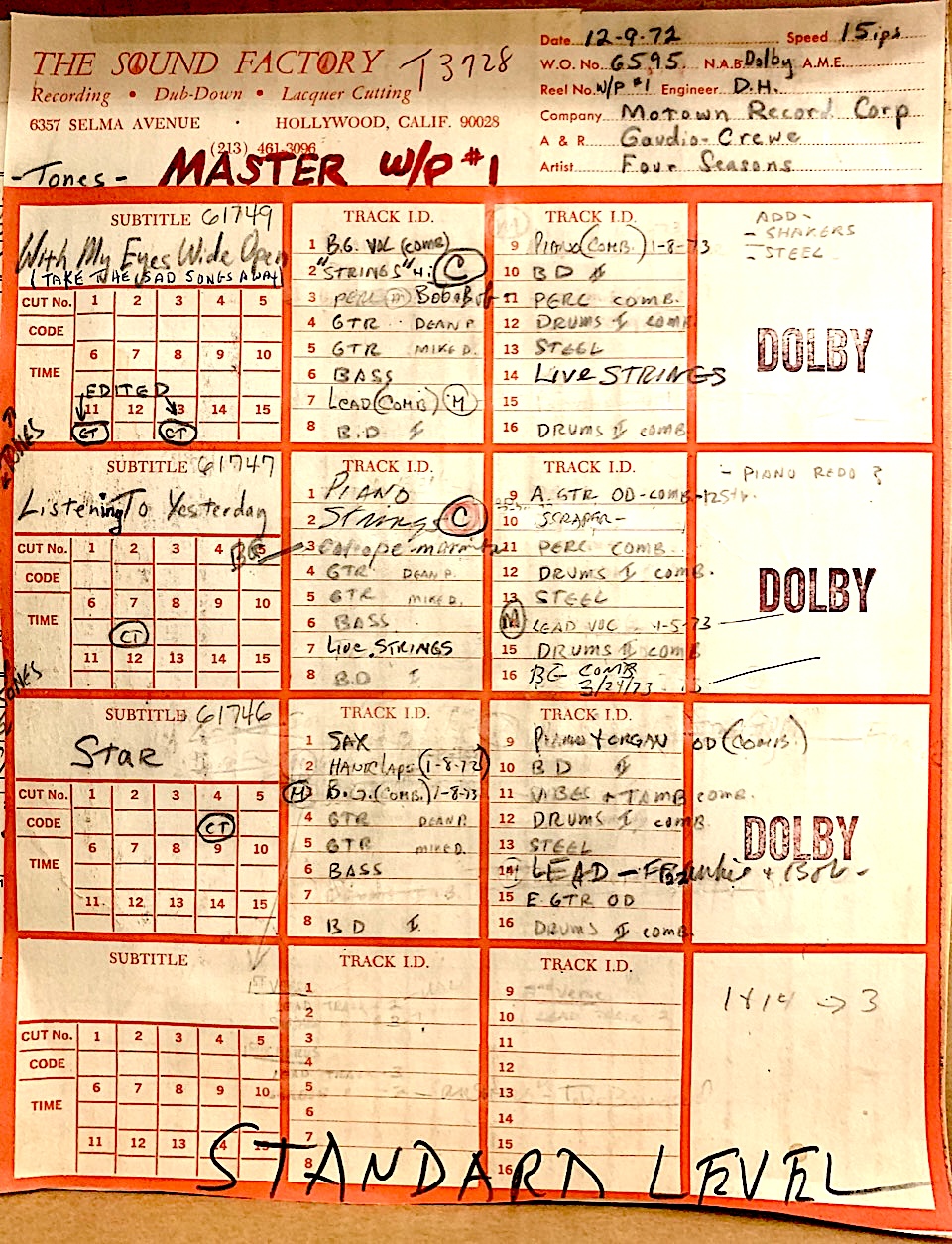
Bob Gaudio was initially reluctant even to review the Motown multi-track tapes, and it took a set of digital transfers, sent to him and Frankie Valli by title alone, before real progress followed. In 2020, Gaudio approved 14 tracks for inclusion — then almost immediately rescinded one, “I Will Love You Like A Man,” without explanation. (The research team’s own best guess, offered for what it’s worth, is that the title’s male-directed wording may have given him pause — but that’s speculation, not a confirmed reason.) That left 13 confirmed, previously unreleased Frankie Valli/Four Seasons Motown recordings for the box set.
A further round of searching by Bill Inglot in the LA storage turned up duplicate “listening mixes” copies, made back in 1973 for Bob Gaudio’s own use — some alternates of the 13 newly approved tracks, others alternates of songs already released. Permission was secured to add these in as bonus material, bringing the Motown portion of the finished box set to 22 tracks in total. Mastering and release were delayed again, this time by a vinyl-pressing-plant backlog, before Snapper Music’s Anthology Box Set finally reached fans in June 2023.